
 Dr. Ronald Steiner

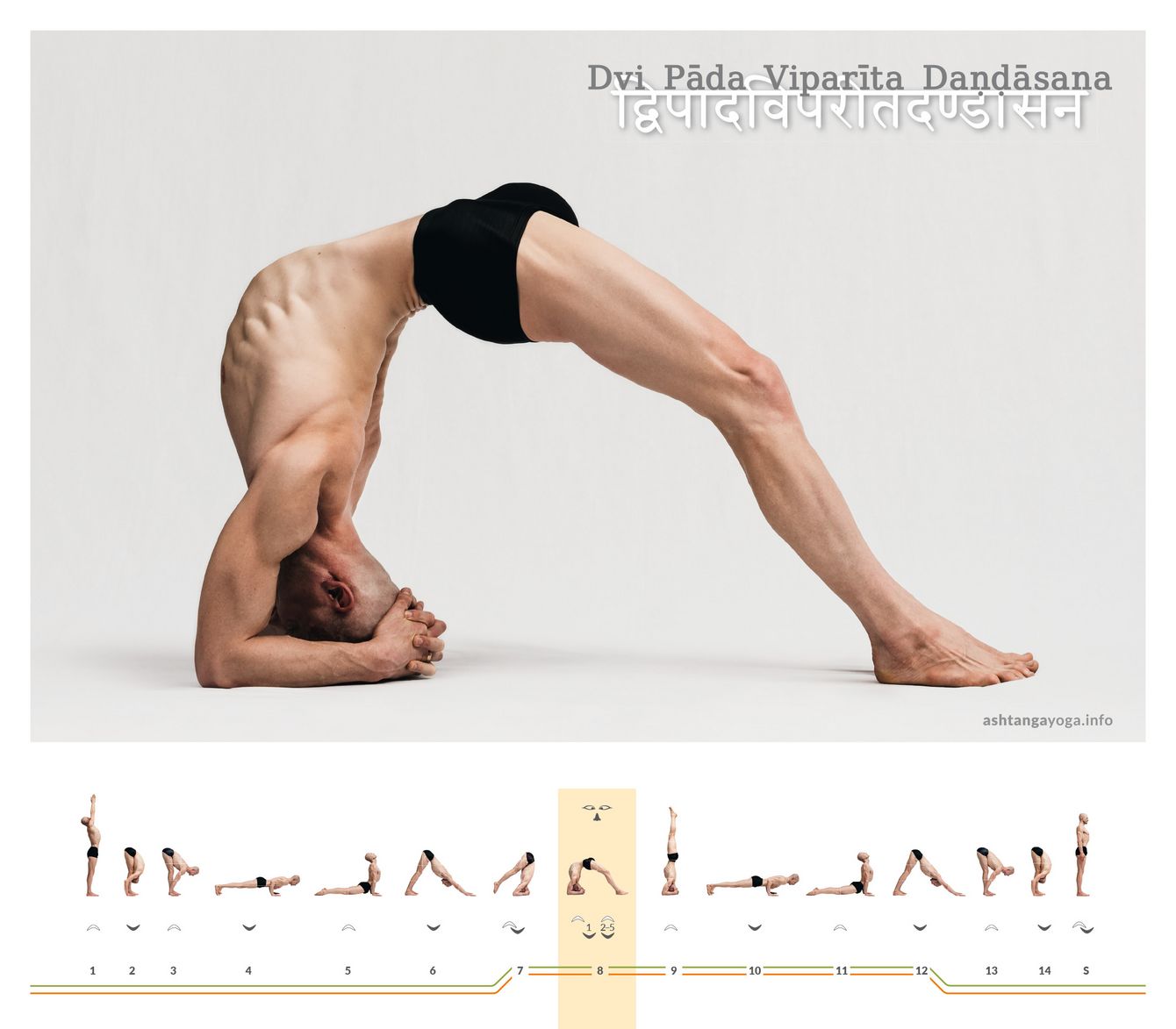
Dvi Pāda Viparīta Daṇḍāsana: the inverted staff
Mythology: Daṇḍa means “staff”—a symbol of axis, order, and uprightness. Viparīta means “inverted”: the staff is turned over, the perspective flips, and what usually supports you must be reorganized. That is the core symbolism of the name: no longer “top holds bottom,” but finding order in the unfamiliar.
In the traditional count: Begin directly from the hold in “Downward-Facing Dog” from the previous sequence.
Vinyāsa 7 – Inhalation, exhalation:
On an inhalation, jump forward between the hands and come to the knees with control. Place the elbows shoulder-width on the floor and interlace the fingers, drawing the little finger inward. Set the crown of the head down while the clasped hands support the back of the head. On the exhalation, straighten the legs while keeping the feet on the floor.
Vinyāsa 8 – Inhalation, exhalation, 5 breaths:
Inhale and lift the straight legs up into headstand. Exhale and place the feet behind the head into the deep backbend. Aim to straighten the knees. Remain in the posture until the fifth exhalation.
Tip: Do not simply “fall” backward. First deepen the backbend. Use the image of touching the back of your head with your feet. Open the chest widely—as if you wanted to reach the floor with the sternum. From there, while maintaining the deep backbend, roll back gently and set the feet down. Only then step the feet slightly away from the head to increase knee extension.
Vinyāsa 9 – Inhalation:
Inhale and lift back out of the backbend into headstand.
Tip: To return to headstand, do not think of “jumping” the feet upward. Instead, walk the feet closer toward the head. Imagine your body forming a wheel: while keeping the backbend, roll toward the chest and draw the feet toward the back of the head. You can roll forward and back a few times. Within this rolling action, a balance phase appears on the crown of the head with the feet hovering just above the floor. Once you can stabilize that phase, pause and then lift the legs back up into headstand.
Vinyāsa 10 to 12:
Follow the vinyāsa flow you already know until you are holding in “Downward-Facing Dog.”
Tip: Jumping from headstand into Caturaṅga Daṇḍāsana should not feel like a falling tree. To control the transition, first lower the straight legs in front of you until the toes hover just above the floor. From there, swing the legs slightly back up—gymnastically, this is a “felge”-like action. The head lifts lightly, giving you the moment to place the hands for Caturaṅga Daṇḍāsana and land with control.
In the traditional count: From here, move directly on into the vinyāsa of the next posture.
Effect: Dvi Pāda Viparīta Daṇḍāsana mobilizes the thoracic spine and shoulder girdle, strengthens the posterior chain, and trains precise load transfer through the forearms and scapular control. When executed cleanly, it creates more breathing space in the chest and a clear “staff-like” axis of uplift. Caution: done poorly, the load quickly shifts into the neck, lumbar spine, or into the wrists and shoulder structures.
Fotograf: Richard Pilnick - www.richardpilnick.com
Messages and ratings