
 Dr. Ronald Steiner

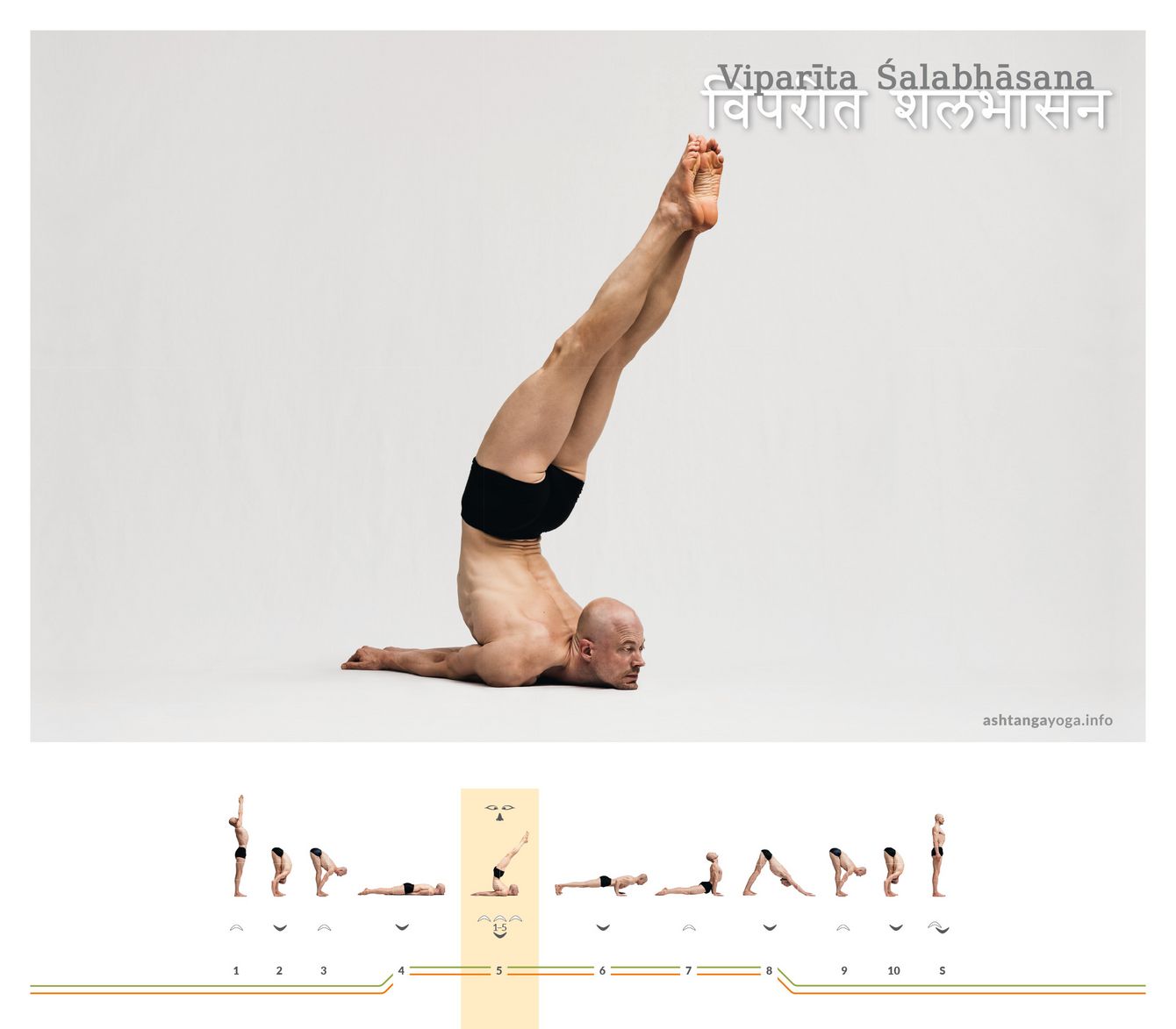
Viparīta Śalabhāsana: The inverted locust
Mythology: Śalabha means “locust”—an image of buoyancy and a sudden, clear upward impulse. Viparīta (“inverted”) turns this principle around: it is not the jump that carries you, but order in the body. You stay grounded and still allow energy to rise. The name is a reminder that “upward” in yoga often grows out of its opposite: stability, humility, and precise organization.
In the traditional count: Begin directly from the hold in “Downward-Facing Dog” from the previous sequence.
Vinyāsa 4 – Inhalation, exhalation:
On an inhalation, glide forward into Plank Pose and, on the exhalation, lower into a prone position. Place your straight arms underneath the torso with the palms facing the floor.
Tip: Place the chin slightly forward on the ground and then draw the chest back. This lengthens the cervical spine and reduces excessive neck hinging when you lift the legs in the next vinyāsa.
Vinyāsa 5 – Inhalation, 5 breaths, inhalation:
Lift into Viparīta Śalabhāsana and remain until the fifth exhalation. Then inhale once more here.
Tip: Lifting the legs from prone can feel impossible at first. Use an easier setup: walk the feet in close to the hands. This creates a deep backbend in the thoracic spine while the knees are still on the floor. Then straighten the legs while keeping the feet on the floor—this deepens the backbend further. Keep pressing the heart space away from the chin into the ground. Only when you feel stable there, slowly lift one leg and then the other. The straight arms gradually take the weight that was previously carried by the feet. This way you rise with control—without “jumping” into the neck.
Vinyāsa 6 – Exhalation:
Lower back down into prone and, still within the exhalation, press up into Caturaṅga Daṇḍāsana.
Tip: To eventually lift both legs together with control, use the exit as eccentric training: press the palms and arms firmly into the floor. Engage the legs through the back line as if you were drawing the feet toward the back of the head. Then lower very slowly, keeping the backbend, rolling down from top to bottom until you arrive prone on the mat again. Once you can do that with control, you can apply the same pattern concentrically on the way into Vinyāsa 5.
Vinyāsa 7 to 8:
Follow the vinyāsa flow you already know until you are holding in “Downward-Facing Dog.”
In the traditional count: From here, move directly on into the vinyāsa of the next posture.
Effect: Viparīta Śalabhāsana strengthens the entire posterior chain (glutes, hamstrings, spinal extensors) and trains the coordination of shoulder girdle and trunk so that lift arises without collapse. When done cleanly, it improves whole-body tone and “buoyancy” in posterior-chain lines; done poorly, the load quickly shifts into the lumbar spine or the neck.
Fotograf: Richard Pilnick - www.richardpilnick.com
Messages and ratings