
 Dr. Ronald Steiner

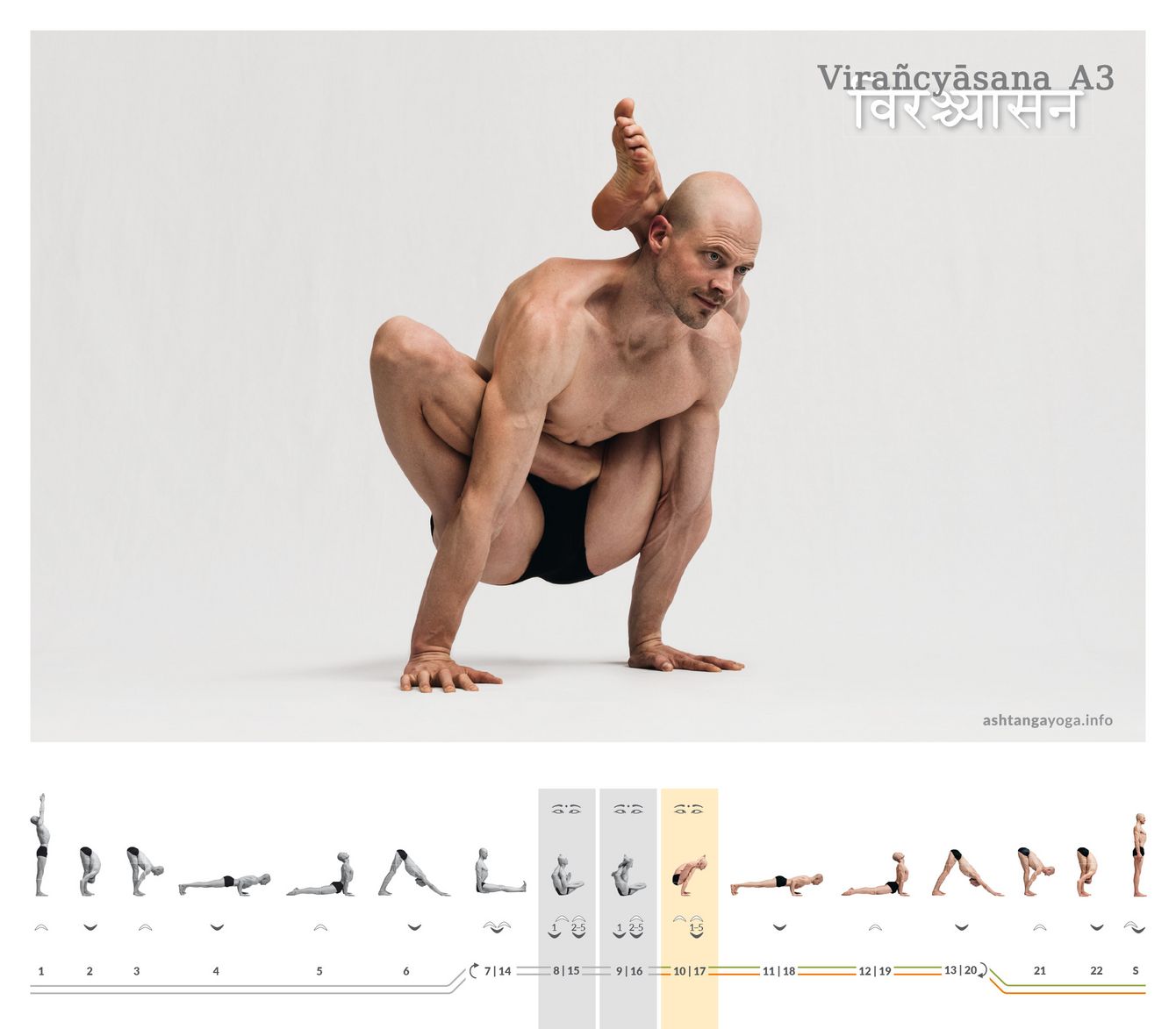
Virañcyāsana A3: Posture of Virañcya
Mythology: Virañcya is an epithet of Brahmā as the principle of creation. In a central imagery of the Purāṇas, Brahmā is described as “lotus-born” (padmaja): he appears on the lotus that grows from the navel of Viṣṇu/Nārāyaṇa (Padmanābha). Creation thus rises from the “ground” of consciousness—clear, upright, and capable of bearing weight. This image fits Virañcyāsana A3 precisely: from the apparent confusion of Lotus and “leg behind the head,” you organize breath and bandha so accurately that you lift into the arm balance. What lifts you is not brute force, but structure—like Brahmā on the lotus.
In the traditional count: Begin directly from the previous posture.
Vinyāsa 10 – Inhalation, 5 breaths:
As you inhale, support yourself with both hands on the floor. Then swing your left knee onto your left upper arm while your right leg remains behind the head. Stay in the posture until the fifth exhalation.
Tip: Place your hands shoulder-width apart and “claw” the fingertips into the floor to keep the wrists stable. Lean the torso slightly forward before lifting—the center of gravity has to be over the hands. Keep the bandhas active and draw the ribs gently inward/upward instead of collapsing into the shoulders. If the lift does not happen, it is usually not a lack of strength, but that the weight is still too far back. At first, keep the left knee between the arms. As you bring the shoulders further forward, you can swing it slightly outward over the left upper arm—this is what makes the posture stable from within.
Vinyāsa 11–13:
Follow the vinyāsa flow you already know until you are holding in “Downward-Facing Dog.”
Vinyāsa 14 to 20:
Then repeat the entire sequence (Vinyāsa 7 to 13) on the other side.
In the traditional count: From here, the vinyāsa continues directly into the next posture.
Effect: Virañcyāsana A3 combines the demands of Lotus and “leg behind the head” with a clear arm-balance component: wrists, forearms, and the shoulder girdle must bear weight while hips and knees remain stable. When built correctly, it develops whole-body coordination, strong core engagement, and a very precise sense of center of gravity and bandha. Caution: if the load tips backward or the shoulders collapse, pressure quickly increases in the wrists and neck—and, with an unstable Lotus, in the knee
Fotograf: Richard Pilnick - www.richardpilnick.com
Messages and ratings