
 Dr. Ronald Steiner

Digāsana A: The posture of the directions
Mythology: Diś means “direction,” and the Dikpālāḥ are the “guardians of the directions.” They embody the idea that space is ordered and that each cardinal direction carries its own quality. In the classical set of eight, the Aṣṭa-Dikpālāḥ, the East is guarded by Indra (royal, vajra/elephant), the Southeast by Agni (fire), the South by Yama (boundary and consequence), the Southwest by Nirṛti (dissolution and what is unclear), the West by Varuṇa (water and cosmic order), the Northwest by Vāyu (wind and movement), the North by Kubera (resources and stability), and the Northeast by Īśāna as an aspect of Śiva (upward orientation). These images form a system that organizes space. Directions become inner reference points from which orientation and stability arise. This is why the Dikpālāḥ also play a role in Vāstu and in temple ground plans, where architecture is understood as aligned and “protected” space. Digāsana recalls this symbolism: you hold a clear axis in space, and stability emerges from that alignment.
In the traditional count: Begin in Samasthitiḥ.
Vinyāsa 1 – Inhalation:
Lift the arms.
Vinyāsa 2 – Exhalation:
Fold forward.
Vinyāsa 3 – Inhalation, 5 breaths:
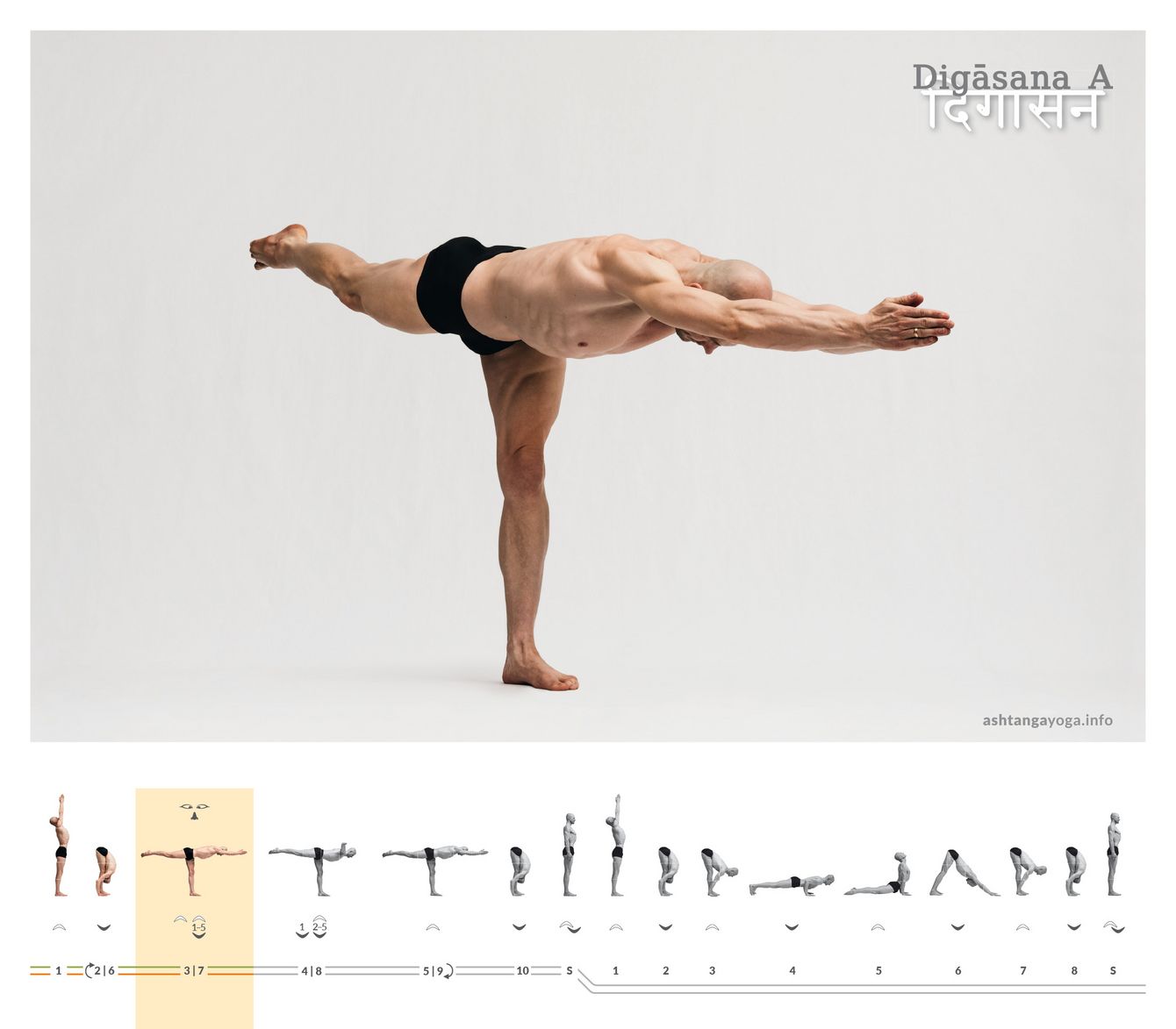
On the inhalation, lift the right leg back and extend both arms forward. Remain in Digāsana A until the fifth exhalation.
Tip: Don’t only “lift” the leg and arms—actively lengthen the two poles away from each other. The lift then happens almost on its own. Keep the pelvis as square as possible. The most common compensation is to open the hip of the lifted leg. That may feel easier, but it makes the posture unstable and undermines its purpose. Press the standing foot firmly into the ground and keep the standing leg long without locking it.
In the traditional count: From here, the vinyāsa flows directly into the next posture.
Effect: Digāsana A strengthens the standing leg, glutes, and trunk and trains the ability to stabilize the hip and spine as one unit. The posture improves balance, coordination, and spatial orientation.
Fotograf: Richard Pilnick - www.richardpilnick.com
Messages and ratings