
 Dr. Ronald Steiner

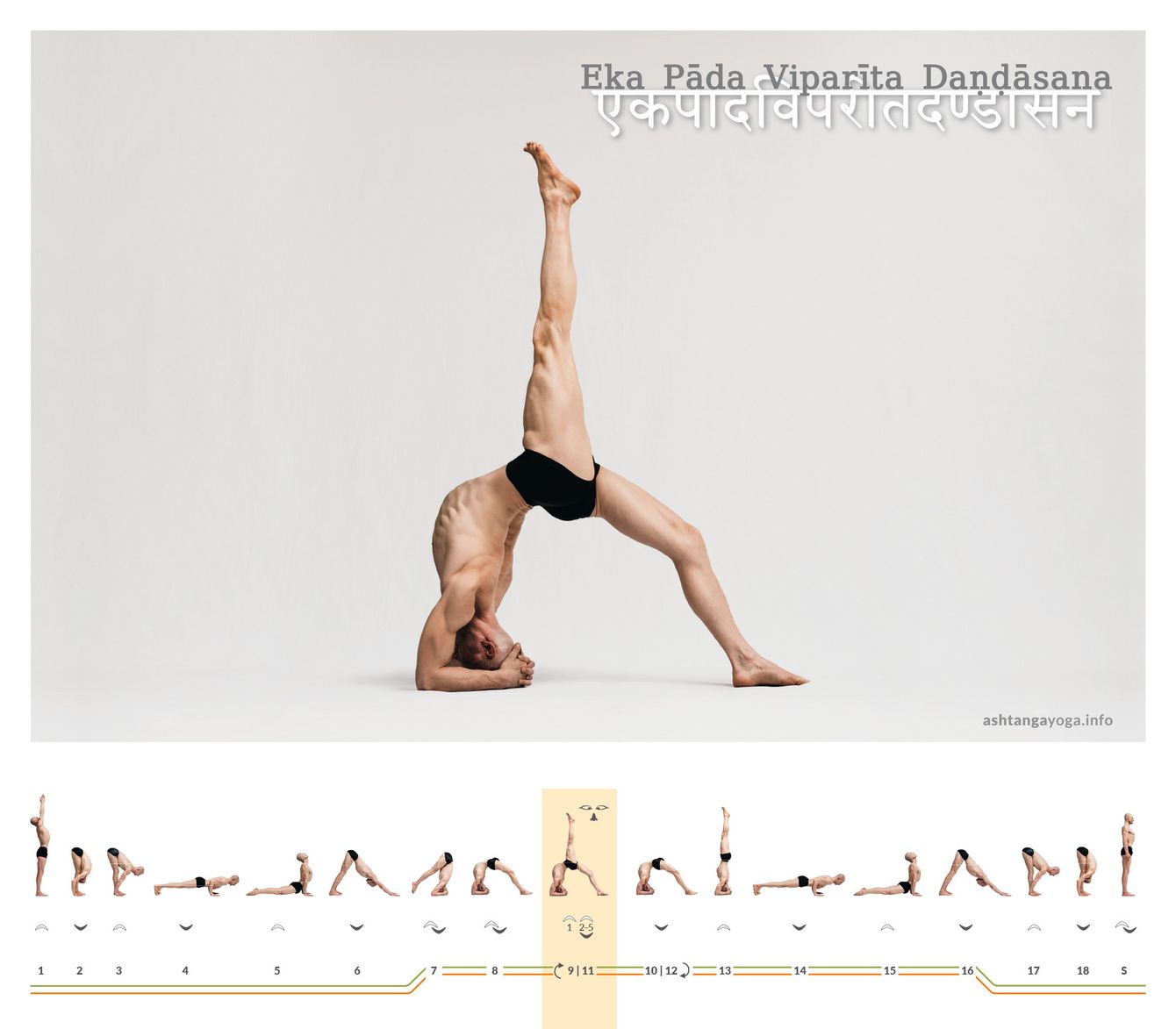
Eka Pāda Viparīta Daṇḍāsana: the inverted staff with one leg
Mythology: Daṇḍa is the “staff”—a symbol of axis, order, and uprightness. Viparīta means “inverted”: the order is turned over, and you must find structure where it is not automatic. Eka (“one”) sharpens the point even further: when only one base truly carries, it’s not strength that decides, but one-pointedness—a clear inner reference that holds the whole together. The name is a reminder that stability often comes from one well-set principle.
In the traditional count: Begin directly from the hold in “Downward-Facing Dog” from the previous sequence.
Vinyāsa 7 – Inhalation, exhalation:
On an inhalation, jump forward between the hands and come to the knees with control. Place the elbows shoulder-width on the floor and interlace the fingers, drawing the little finger inward. Set the crown of the head down while the clasped hands support the back of the head. On the exhalation, straighten the legs while keeping the feet on the floor.
Vinyāsa 8 – Inhalation, exhalation:
Inhale and lift the straight legs up into headstand. Exhale and place the feet behind the head into the deep backbend. Aim to straighten the knees.
Tip: Don’t simply tip backward. First build the backbend. Imagine you want to touch the back of your head with your feet, and open the chest wide—as if drawing the sternum toward the floor. Keep that depth and then roll back with control until the feet land. Only after that, step the feet slightly away from the head to increase knee extension.
Vinyāsa 9 – Inhalation, 5 breaths:
Inhale and lift one leg up with control, staying until the fifth exhalation.
Tip: Don’t “kick” the leg up—lengthen it upward. First stabilize the pelvis, then let the length arise. Keep the chest wide and the ribs organized so the backbend stays in the thoracic spine instead of collapsing into the neck/lumbar spine. The standing leg remains active and grounded; if that foot drifts away behind you, you lose the axis.
Vinyāsa 10 – Exhalation:
Exhale and place the foot back down behind the head.
Vinyāsa 11–12:
Repeat the entire sequence (Vinyāsa 9 to 10) on the other side.
Vinyāsa 13 – Inhalation:
Inhale and lift out of the backbend back into headstand.
Tip: To return to headstand, don’t try to “jump” the feet up. Take the opposite route: step the feet gradually closer to the head. Imagine your body like a wheel and, while maintaining the backbend, roll toward the chest as you draw the feet toward the back of the head. Repeat this rocking forward and back a few times. A brief balance appears on the crown with the feet hovering just above the floor. Once you can stabilize that hover, pause there and lift the legs back into headstand with control.
Vinyāsa 14 to 16:
Follow the vinyāsa flow you already know until you are holding in “Downward-Facing Dog.”
Tip: The jump from headstand into Caturaṅga Daṇḍāsana must not feel like a tree falling. For control, first lower the straight legs forward until the toes hover just above the floor. From there, swing the legs back up with a light impulse—gymnastically, a “felge”-like action. This briefly unloads the head, giving you the moment to place the hands for Caturaṅga Daṇḍāsana and land cleanly and under control.
In the traditional count: From here, move directly on into the vinyāsa of the next posture.
Effect: Eka Pāda Viparīta Daṇḍāsana deepens the work from the previous posture and adds a one-leg logic: you train axial stability, a thoracic backbend, and powerful load distribution through the forearms, scapular control, and the grounded leg. Done well, it creates a large breathing space in the chest and a very clear sense of center of gravity; done poorly, the load quickly shifts into the neck, lumbar spine, or the shoulder joint
Fotograf: Richard Pilnick - www.richardpilnick.com
Messages and ratings