
 Dr. Ronald Steiner

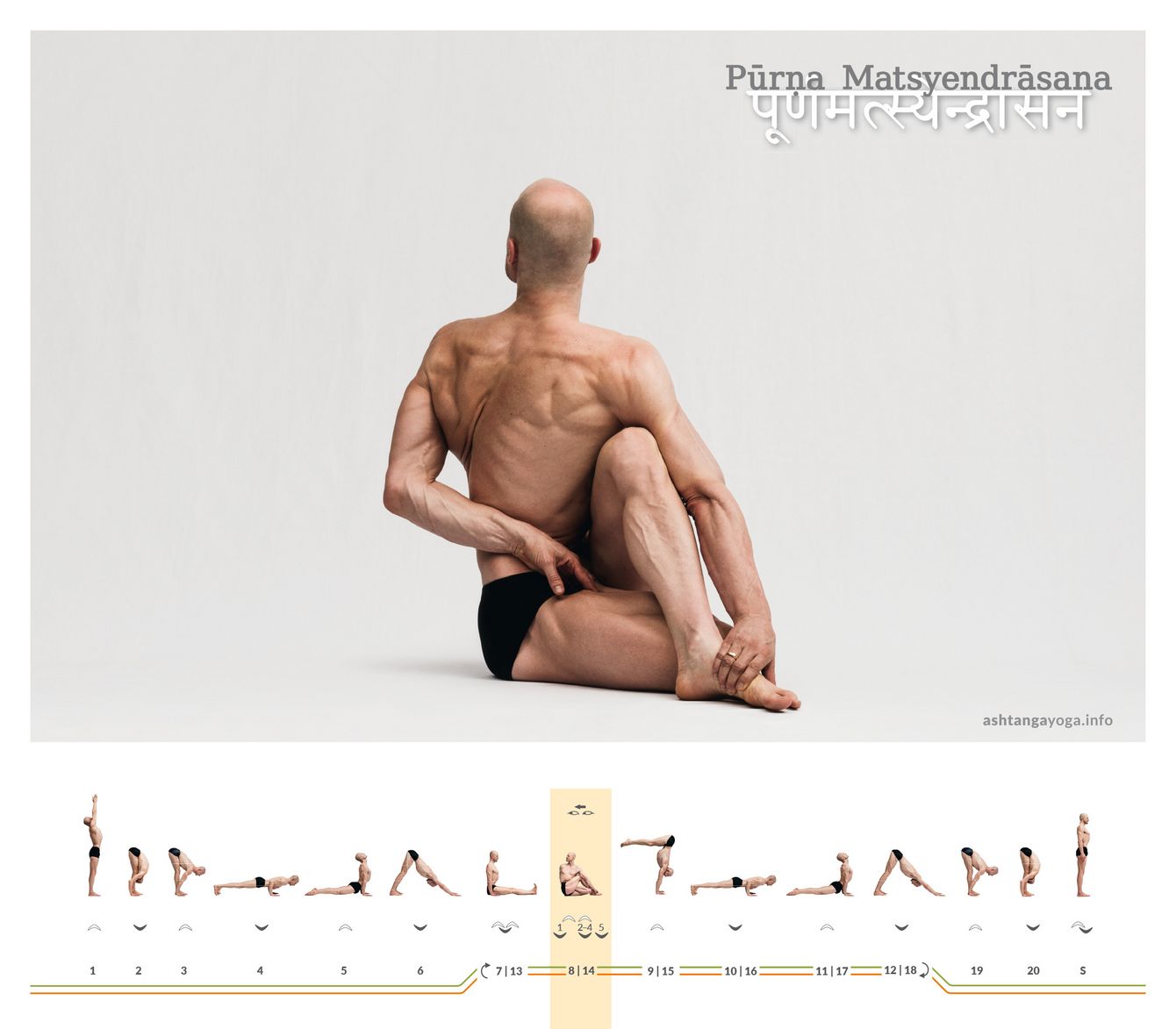
Pūrṇa Matsyendrāsana: The complete pose named after Matsyendranātha
Mythology: This posture is named after Matsyendranātha (often shortened to Matsyendra), a legendary figure of the Nātha tradition and therefore part of the early Haṭhayoga transmission. A well-known story tells that Śiva shared secret yogic teachings with his consort Pārvatī—and Matsyendranātha overheard them unnoticed in the form of a fish. Through powerful yogic techniques he transformed from fish to human and later brought these methods into the world. This matches the symbolism of twisting: You “turn” inward, compress and clarify, and then emerge more upright and freer.
In the traditional count: Start directly from the hold in “Downward-Facing Dog” from the previous vinyāsa sequence.
Vinyāsa 7 – Inhalation, exhalation, inhalation:
From “Downward-Facing Dog,” push off as you inhale. Glide forward and up into a balance on the hands. During the exhalation, keep your legs firmly together and draw them straight through between the arms. Finally, inhale into a staff pose with the legs extended.
Vinyāsa 8 – Exhalation, inhalation, 5 breaths:
As you exhale, fold your left leg into Half Lotus and place your right foot on the outside of the left knee. Inhale, twist to the right, and take hold of your right foot with your left hand. Reach your right arm behind your back and find support at the left groin. Stay here until the fifth inhalation. On the fifth exhalation, unfold your legs and place your hands on the floor.
Tip: First bring the heel of the left leg to your navel before placing the foot into Lotus. This helps you position the foot high up in the groin. Then the movement of the right leg does not create additional leverage on your left knee joint. Now press the top of the left foot from the inside against the base of the right thigh. This stabilizes the left knee joint and also creates space in the right hip joint for the movement.
Vinyāsa 9 to 12:
Follow the vinyāsa flow you already know until you are holding in “Downward-Facing Dog.”
Vinyāsa 13–14:
Repeat the sequence from Vinyāsa 7–8 on the left side.
Vinyāsa 15 to 18:
Follow the vinyāsa flow you already know until you are holding in “Downward-Facing Dog.”
In the traditional count: From here, move directly on into the vinyāsa of the next posture.
Effect: Pūrṇa Matsyendrāsana is a deep rotation that primarily mobilizes the thoracic spine and ribs while requiring stable work from the hip and gluteal muscles. When taught well it improves rotational capacity, upright posture, and breathing space—done poorly it quickly becomes a “strain from the lower back,” so: rotate mainly through the rib cage, keep the pelvis steady.
Fotograf: Richard Pilnick - www.richardpilnick.com
Messages and ratings