
 Dr. Ronald Steiner

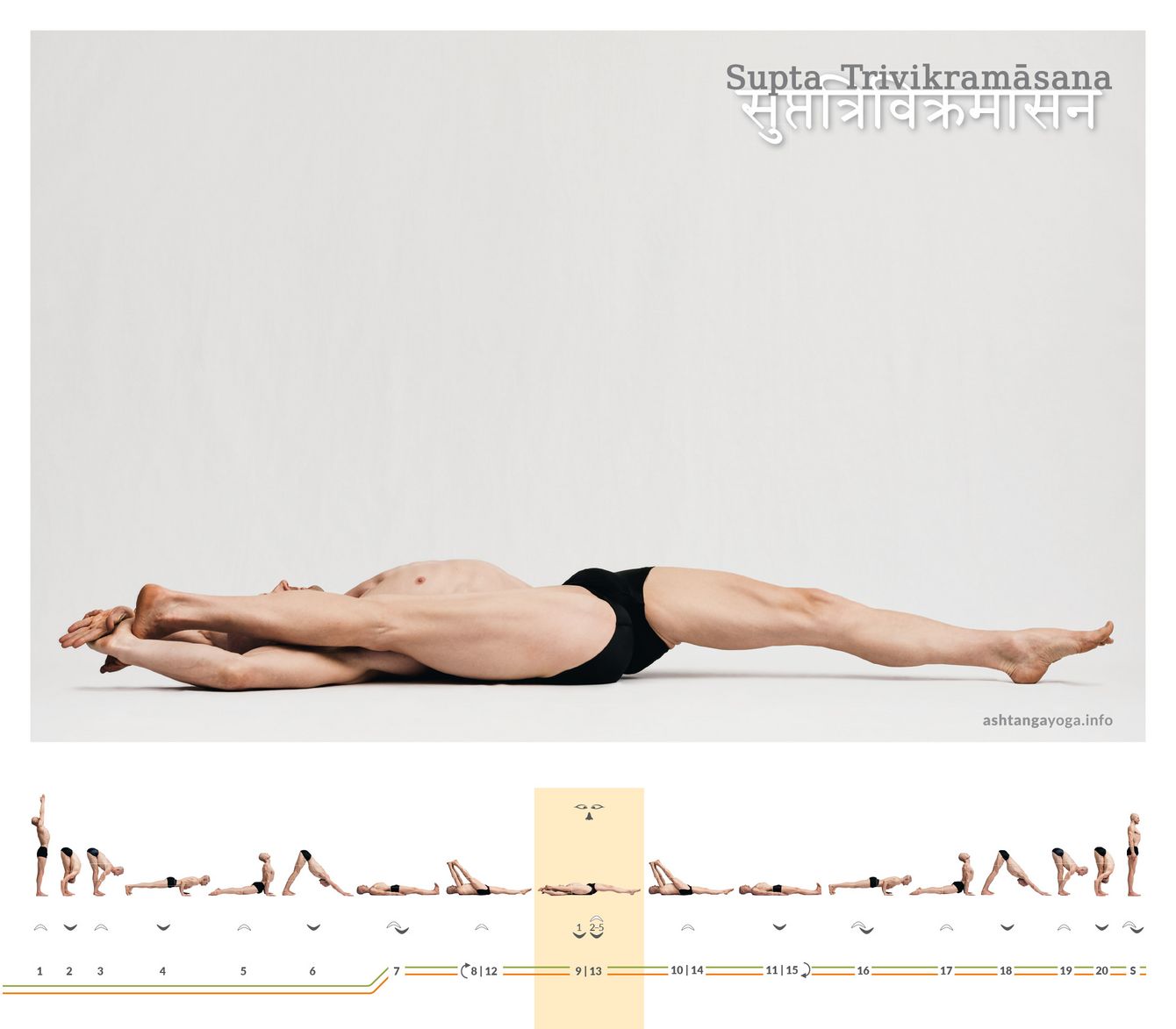
Supta Trivikrāmāsana: The reclining Trivikrama
Mythology: The Vāmana and Trivikrama story comes from the Purāṇa tradition and is especially well known from the Bhāgavata Purāṇa. In this account, the Asura king Bali becomes so powerful that he takes supremacy from the gods, the Devas. The Devas turn to Viṣṇu and ask him to restore balance. Viṣṇu chooses no battle, but a clever, non-violent strategy. He appears as Vāmana, a small Brahmin dwarf, and approaches Bali, who is famous for generosity.
Vāmana asks Bali for a seemingly harmless gift: as much land as he can measure in three steps. Bali agrees—partly out of honor, partly because the request seems laughably small. In that moment, Vāmana expands into the cosmic form Trivikrama. With the first step he takes the earth, with the second the sky. For the third step there is no space left. Bali realizes who stands before him and offers his own head as the place for the third step. Viṣṇu places his foot on Bali’s head and presses him down into the underworld Sutala, while granting him protection and a special status.
This is why the story matters for Trivikrama: it portrays power as measure, clarity, and principle rather than violence. A small, precise “step” overturns an entire world order—not by force, but through truth, timing, and alignment.
In the traditional count: Begin directly from the hold in “Downward-Facing Dog” from the previous sequence.
Vinyāsa 7 – Inhalation, exhalation:
On an inhalation, jump forward between the hands. On the exhalation, lie flat on your back.
Vinyāsa 8 – Inhalation:
Inhale and lift your right leg. Hold it with your hands so that your right hand grips your left wrist.
Tip: To make the grip easier, first “hook” the outer edge of the right foot into the back of your right hand with a small impulse. Then lift the left hand and let the right hand catch the left wrist.
Vinyāsa 9 – Exhalation, 5 breaths:
On the exhalation, guide the leg with control past the head and shoulder line and take the foot. Remain in Supta Trivikrāmāsana until the fifth exhalation.
Tip: In the ideal form, the toes touch the floor without the leg drifting too far to the side. At the same time, the thigh must externally rotate so the leg can pass the ribcage. Keep the line as clear as possible and rotate only as much as necessary.
Vinyāsa 10 – Inhalation:
Inhale and lift the leg back up, analogous to Vinyāsa 8.
Vinyāsa 11 – Exhalation:
On the exhalation, lie flat on your back again.
Vinyāsa 12–15:
Repeat the sequence on the second side.
Vinyāsa 16–20 and Samasthitiḥ:
Through a backward roll (Cakrāsana – Vinyāsa 16), follow the vinyāsa flow you already know until you return to neutral standing.
In the traditional count: From here, move directly on into the vinyāsa of the next posture.
Effect: Supta Trivikrāmāsana primarily opens external rotation in the hip and stretches the back line of the leg, while the pelvis and trunk should remain stable. Practiced cleanly, the posture develops a clear leg line, improves hip mobility, and has a balancing effect on the pelvis.
Fotograf: Richard Pilnick - www.richardpilnick.com
Messages and ratings