
 Dr. Ronald Steiner

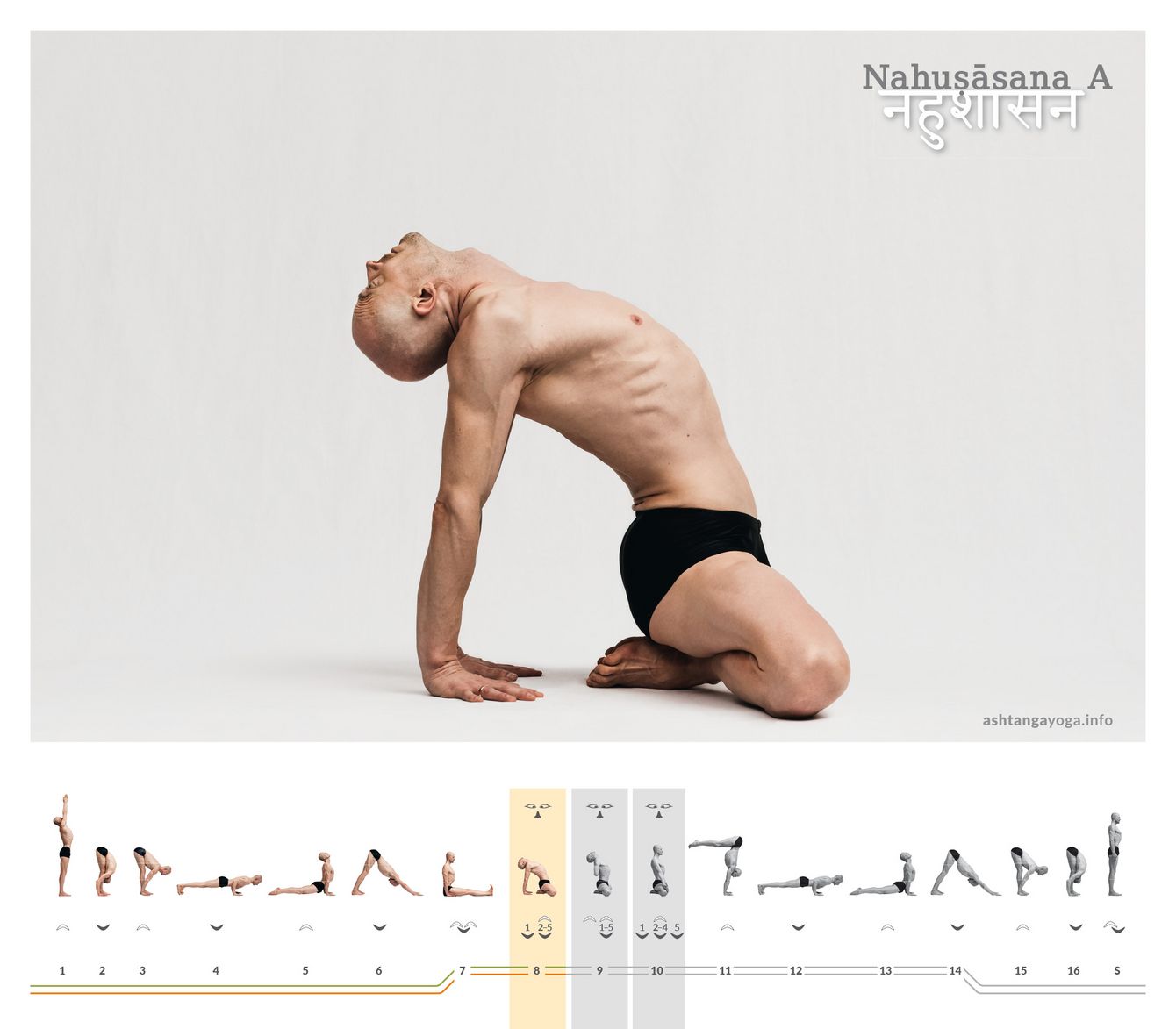
Nahuṣāsana A: The posture of Nahuṣa
Mythology: Nahuṣa is a mythical king of the Candravaṃśa (Moon Dynasty). In the traditions he is described as the son of Āyu and the father of Yayāti, placing him at the beginning of important royal lineages. What matters most, however, is his reputation: Nahuṣa is portrayed as capable, just, and order-creating—someone able to carry responsibility. When Indra, king of the Vedic gods, temporarily disappears, a power vacuum threatens the heavens, and precisely because of his good name Nahuṣa is appointed as his representative. The message is clear: a human being can grow beyond himself through virtue. When you know your orientation, you act free from selfish motivation. This devotion to the task clarifies the mind and makes action “pure” and sustainable.
In the traditional count: Begin directly from the hold in Adho Mukha Śvānāsana from the previous sequence.
Vinyāsa 7 – Inhalation, exhalation, inhalation:
On the inhalation, jump forward between the hands. On the exhalation, come into a seated position with control. Complete the movement by straightening the legs and inhaling.
Vinyāsa 8 – Exhalation, 5 breaths:
As in Mūla Bandhāsana, place the feet, then roll with control over them until the pelvic floor is positioned on the heels. In Nahuṣāsana A, support the hands behind the back and lift the heart space upward. Remain here until the fifth exhalation.
Tip: First establish the foundation (feet/pelvis/knees) as in Mūla Bandhāsana. In Nahuṣāsana A, use the hands as supports to lift the chest forward and up without pushing the ribs forward. Press the hands actively into the floor, draw the shoulder blades back and down, and keep a subtle tension between the hyoid bone and the sternum so the upward gaze does not collapse into a neck hinge.
In the traditional count: From here, the vinyāsa continues directly into the next posture.
Effect: Nahuṣāsana A is an intense hip opener and combines it with an active opening of the chest. You train upright alignment and the ability to distribute tension upward rather than collecting it in the pelvis or the knees.
Fotograf: Richard Pilnick - www.richardpilnick.com
Messages and ratings