
 Dr. Ronald Steiner

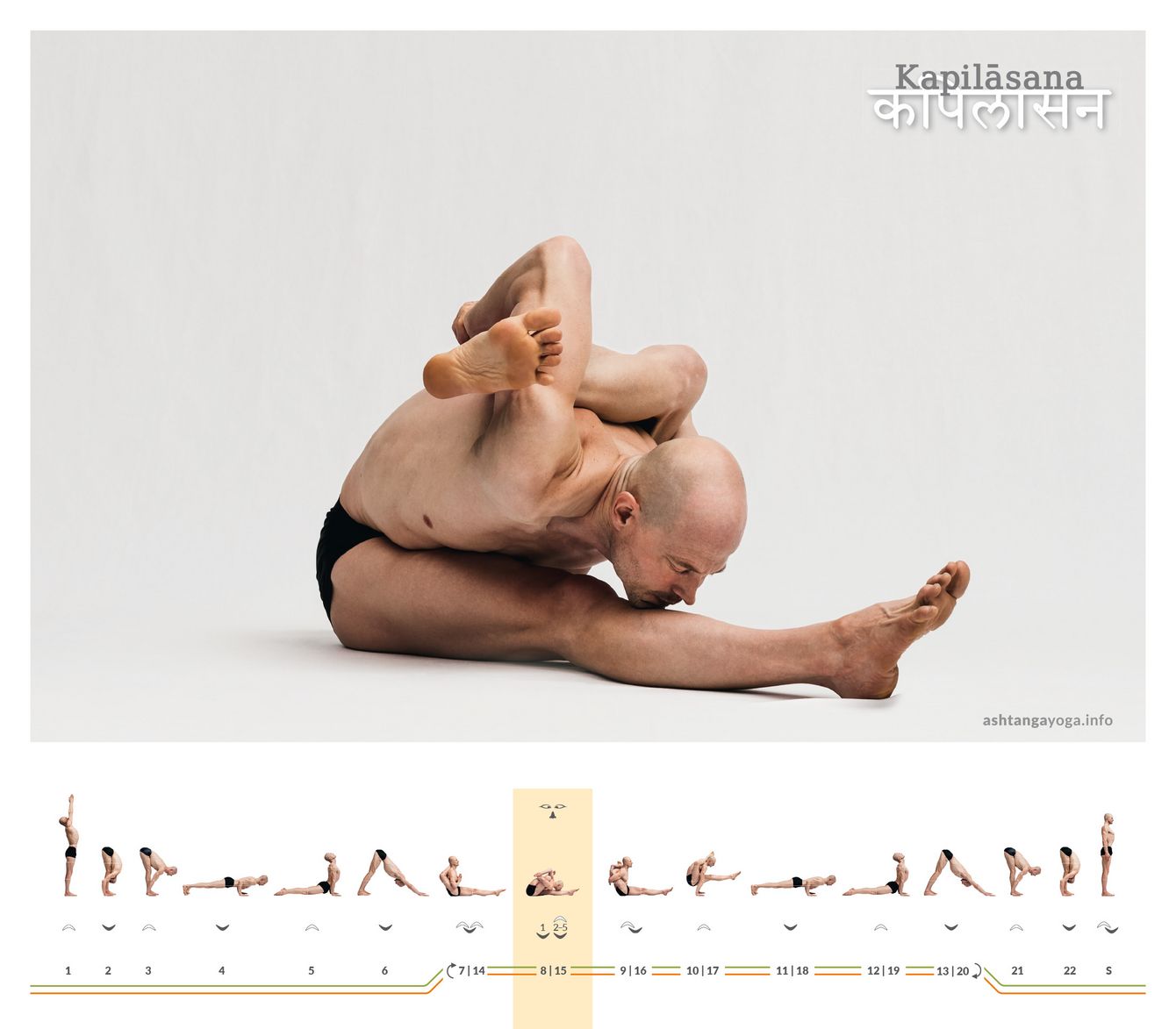
Kapilāsana: The posture of Kapila
Mythology: The name refers to Kapila, a legendary Ṛṣi who is regarded in tradition as the founder or principal teacher of Sāṃkhya—a system that analyzes reality with sober precision until clarity arises. Kapila’s gaze is not “mystical,” but exact: he separates what is essential from what is not until the mind becomes quiet. In later traditions, Kapila also appears as an embodiment of insight itself. This motif fits as a guiding image: Kapilāsana works like a “knot” that forces you to let go of what is unnecessary. You can only move forward if you remain calm at the core, keep the structure clean, and clarify step by step.
In the traditional count: Begin directly from the hold in Adho Mukha Śvānāsana from the previous sequence.
Vinyāsa 7 – Inhalation, exhalation, inhalation:
On the inhalation, jump forward. Swing the right leg outside the right arm. On the exhalation, place the right foot behind the head. Complete the movement on the inhalation by straightening the left leg and bringing the hands together in front of the heart.
Vinyāsa 8 – Exhalation, 5 breaths:
Just as in Buddhāsana, reach with the right hand under the left armpit to the right shin. Draw the right foot deeper along the back and then forward under the left armpit. Circle the left upper arm back over the instep of the right foot. Now, however, reach the right hand around the outside of the right thigh and grasp the left wrist. On the exhalation, fold forward over the straight left leg and remain in Kapilāsana until the fifth exhalation.
Tip: As in Buddhāsana, drawing the right foot forward under the left armpit is often the hardest part while sitting upright. Make it easier by leaning diagonally down to the left immediately after taking the grip on the right shin. Support yourself on the left forearm, with the elbow bent about 90°. In this side-supported position, it becomes much easier to “feed” the instep of the right foot forward under the left armpit. Then sit back up.
Vinyāsa 9 – Inhalation:
On the inhalation, lift back up while keeping the bind under control. Exhale here.
Vinyāsa 10 to 13:
Follow the vinyāsa flow you already know until you are holding in Adho Mukha Śvānāsana.
Vinyāsa 14 to 20:
Repeat the entire sequence on the other side, then follow the familiar vinyāsa flow again until you are holding in Adho Mukha Śvānāsana.
In the traditional count: From here, continue directly into the movement flow of the next posture.
Effect: Kapilāsana intensely opens hip external rotation and mobilizes the gluteal and groin region, while the forward fold stretches the back of the leg and strongly organizes the trunk. The posture also develops scapular mobility and trains concentration, calm breathing, and the ability to dose tension precisely.
Fotograf: Richard Pilnick - www.richardpilnick.com
Messages and ratings