

 Dr. Ronald Steiner

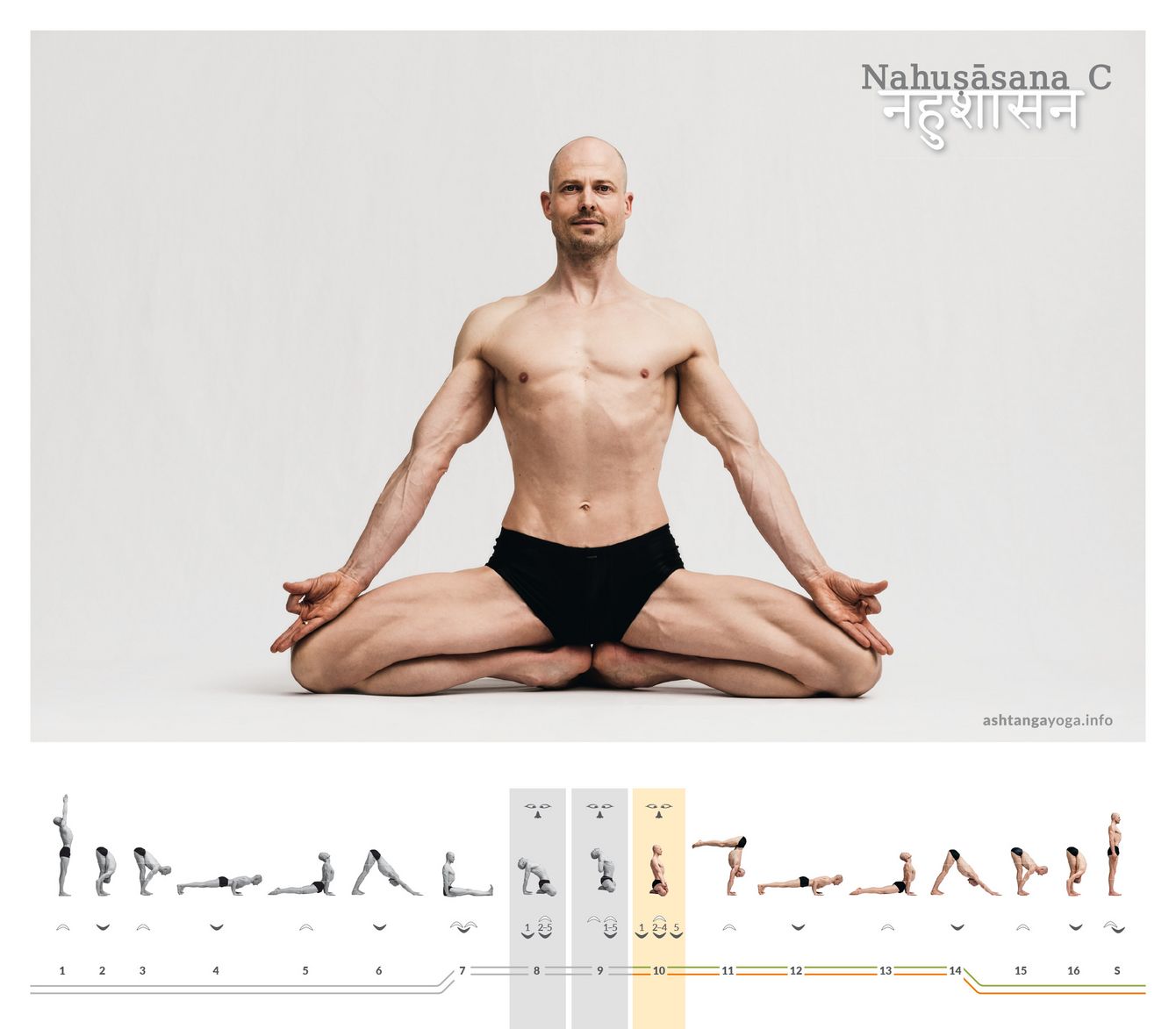
Nahuṣāsana C: The posture of Nahuṣa
Mythology: After King Nahuṣa is cursed for his arrogance to exist in the form of a serpent (sarpa/nāga), he appears again later in the Mahābhārata. There he encounters the Pāṇḍavas, the five brothers Yudhiṣṭhira, Bhīma, Arjuna, Nakula, and Sahadeva, and holds Bhīma—the strongest of them—so the group cannot simply “push through” with force. Instead of violence, a dialogue unfolds: Yudhiṣṭhira meets Nahuṣa and speaks with him about dharma, meaning truth, measure, responsibility, and right action. The core of the story is the turn: liberation comes not through strength, but through insight. Nahuṣa recognizes his error, and through the clarity of this dialogue his curse is dissolved. The message is unmistakable: integrity can lift you up—even after a deep fall.
In the traditional count: Begin directly from the previous posture.
Vinyāsa 10 – Exhalation, 5 breaths:
For Nahuṣāsana C place with the exhalation the hands in Cinmudrā on the knees. Lower the gaze to the tip of the nose. Remain here until the fifth exhalation.
Tip: Nahuṣāsana C is the quietest and most meditative of the three Nahuṣāsanas. Keep pelvis and knees stable, lengthen the spine upward, and let the shoulders soften down. Cinmudrā is symbolic: the index finger represents the ego, which bows to the divine—the thumb.
Vinyāsa 11 – Inhalation:
At the very end of the fifth exhalation, place the hands on the floor in front of the shins. On the inhalation, lift up into the “tuck handstand.”
Vinyāsa 12 to 14:
Follow the vinyāsa flow you already know until you are holding in “Downward-Facing Dog.”
In the traditional count: From here, continue directly into the movement flow of the next posture.
Effect: Nahuṣāsana C combines intense hip opening with inner gathering. You train pelvic-floor awareness, upright alignment, and a calm breath—without letting the energy spill outward through chest opening
Fotograf: Richard Pilnick - www.richardpilnick.com
Messages and ratings