

 Dr. Ronald Steiner

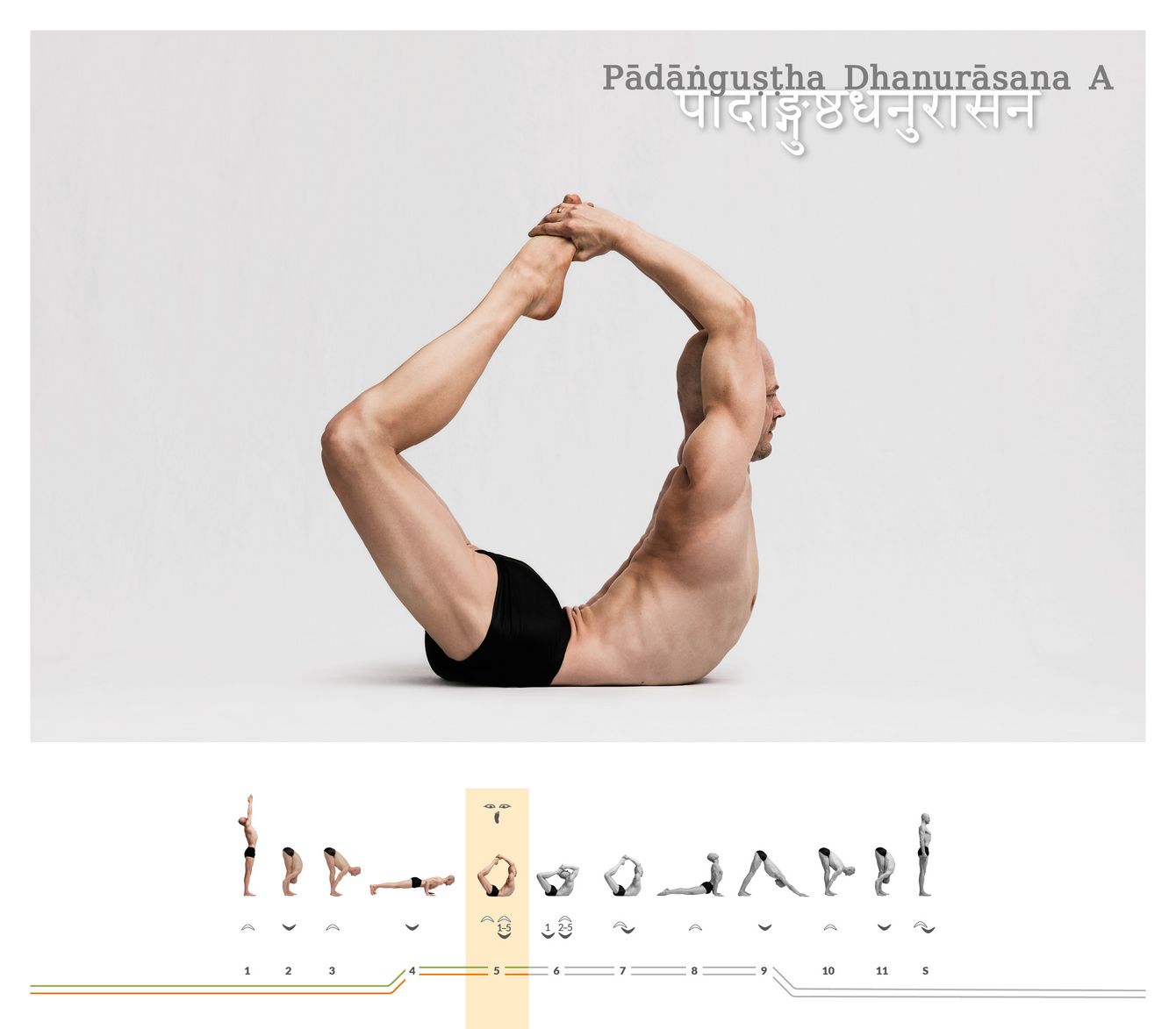
Pādāṅguṣṭha Dhanurāsana A: The Extended Bow at the Big Toe
Mythology: Dhanus means “bow,” and pādāṅguṣṭha is the “big toe.” The name may sound technical, yet it carries a clear principle: a large form arises from a small, precise reference point. The bow stands for directed power; the big toe stands for exact connection. When the grip is clean, tension becomes evenly distributed—and from that, spaciousness arises.
In the traditional count: Begin directly from the hold in Adho Mukha Śvānāsana from the previous sequence.
Vinyāsa 4 – Inhalation, exhalation:
On the inhalation, shift forward into a plank-like position, then on the exhalation lower with control into a prone position.
Vinyāsa 5 – Inhalation, 5 breaths:
With the inhalation, take hold of the big toes. Extend arms and legs upward and establish Pādāṅguṣṭha Dhanurāsana A. Remain until the fifth exhalation.
Tip: To catch the big toes, first reach in from the side with the elbows close to your ribs and hook the outer edge of the foot. The palm faces outward and the thumb points upward. Draw the foot close toward the shoulder. Repeat the same action on the second side. Then rotate one elbow and then the other upward. After that, extend arms and legs. When you build tension by pressing the legs back, a pleasant spaciousness arises in the heart area.
In the traditional count: From here, the movement flow continues directly into the next posture.
Effect: Pādāṅguṣṭha Dhanurāsana A creates spaciousness in the heart area and across the entire front line of the body
Fotograf: Richard Pilnick - www.richardpilnick.com
Messages and ratings